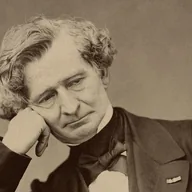
Berlioz was born in La Côte-Saint-André and left medical studies for music, entering the Paris Conservatoire in 1826 and winning the Prix de Rome in 1830. His opera Benvenuto Cellini (1838) failed, and he found a larger audience as a conductor in Germany, Britain and Russia. His Treatise on Instrumentation remained a standard book on orchestration for the rest of the century.
He is known above all for orchestral colour and for avoiding regular four- and eight-bar phrases in favour of irregular rhythms. In the Symphonie fantastique (1830) a recurring melody, the idée fixe, stands for the artist's loved one and returns in all five movements. The score asks for about ninety players, with bells, ophicleides, two harps in the waltz, a cor anglais answered by an offstage oboe, and four timpani. Harold en Italie (1834) began as a viola piece for Paganini. The solo viola represents Harold, but the part is not written as a showy concerto.
Les nuits d'été sets six poems by Théophile Gautier, first with piano (1840 to 1841), then orchestrated between 1843 and 1856; the orchestra has no percussion. The Roman Carnival Overture (1843) reuses material from Benvenuto Cellini and gives the cor anglais a prominent solo. The Queen Mab scherzo is the fourth of seven movements in the dramatic symphony Roméo et Juliette (1839). It is purely orchestral, since the voices appear only in movements 1, 5 and 7, and it draws on what Berlioz had learned from Beethoven's scherzos about picturing a delicate fairy queen.
What to listen for
- The idée fixe: learn it in the first movement's Allegro, then catch it again in the ball, the fields, the march and the witches' finale.
- Scoring as a signal: bells, two harps, the cor anglais answered by an offstage oboe, and the Dies irae chant for the dead in the finale.
- In Harold en Italie, the solo viola as Harold, who stands apart from the scenes around him rather than competing with the orchestra.
- In Les nuits d'été, six different moods, each with its own small orchestral colour.
- Phrases that do not fall into regular four-bar units, so a melody keeps surprising you with where it ends.
Sources: Hector Berlioz (Wikipedia), Symphonie fantastique (Wikipedia), Harold in Italy (Wikipedia), Les nuits d'été (Wikipedia), Roman Carnival Overture (Wikipedia), Roméo et Juliette (Berlioz) (Wikipedia)