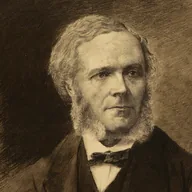
1822–1890 · Romantic
César Franck
6 works

Franck was born in Liège and made his career in Paris. He was organist at Sainte-Clotilde from 1859 until his death and taught at the Conservatoire from 1872. His skill at improvising and the Cavaillé-Coll organ at Sainte-Clotilde shaped his writing: dense contrapuntal textures, wide-spread chords, and harmony that slides through remote keys. His pupils remembered his advice to "modulate, modulate". The influence of Liszt and Wagner is clear in the chromatic harmony.
His best-known method is cyclic form: the main themes of a work grow from one germinal motif and return in later movements, usually transformed. The catalog shows this at every size. The Violin Sonata (1886, a wedding gift for Eugène Ysaÿe) brings back its rocking opening theme and ends with violin and piano in canon. The String Quartet in D major (1889 to 1890, his only quartet, about 50 minutes) recalls its slow introduction in later movements and layers the cyclic themes in its coda. The Symphony in D minor (1886 to 1888) has three movements, each referring back to the opening theme, and its finale restates that theme in triumph.
The other works show other sides. The Symphonic Variations (1885) for piano and orchestra play as one span with three sections, from F-sharp minor to a bright F-sharp major finale. Le chasseur maudit (1882) is a symphonic poem after a ballad by Bürger, in four sections that run from a peaceful Sunday landscape to the demons' chase. Choral No. 3 in A minor was among his last organ pieces, written in 1890 in free, rhapsodic form.
What to listen for
- In the Violin Sonata, the gentle rocking theme of the first movement and how it comes back, changed, in the later movements and in the finale's canon.
- In the String Quartet, the slow opening Lied (as d'Indy named it) that returns later, and the finale's opening unison that recalls earlier themes.
- In the Symphony, the cor anglais melody over plucked strings and harp in the second movement, and the finale's coda that restates the opening theme.
- In Choral No. 3, the toccata-like sixteenth-note figures at the start, with the chorale theme arriving only later, from bar 30.
- In Le chasseur maudit, the four sections, from the peaceful Sunday landscape through the hunt and the curse to the demons' chase.
- Harmony that never stays long in one key: frequent modulations to distant keys.
Sources: César Franck (Wikipedia), Trois Chorals (Wikipedia), Violin Sonata (Franck) (Wikipedia), Symphonic Variations (Franck) (Wikipedia), Le chasseur maudit (Wikipedia), String Quartet (Franck) (Wikipedia), Symphony in D minor (Franck) (Wikipedia)