Path 03
Calm classical music
Twelve slow, quiet pieces, from Chopin's lullaby to Pärt's Fratres.
Chopin → Liszt → Wagner → Debussy → Massenet → Fauré → Grainger → Delius → Vaughan Williams → Rachmaninoff → Pärt
1873–1943 · Late Romantic
17 works
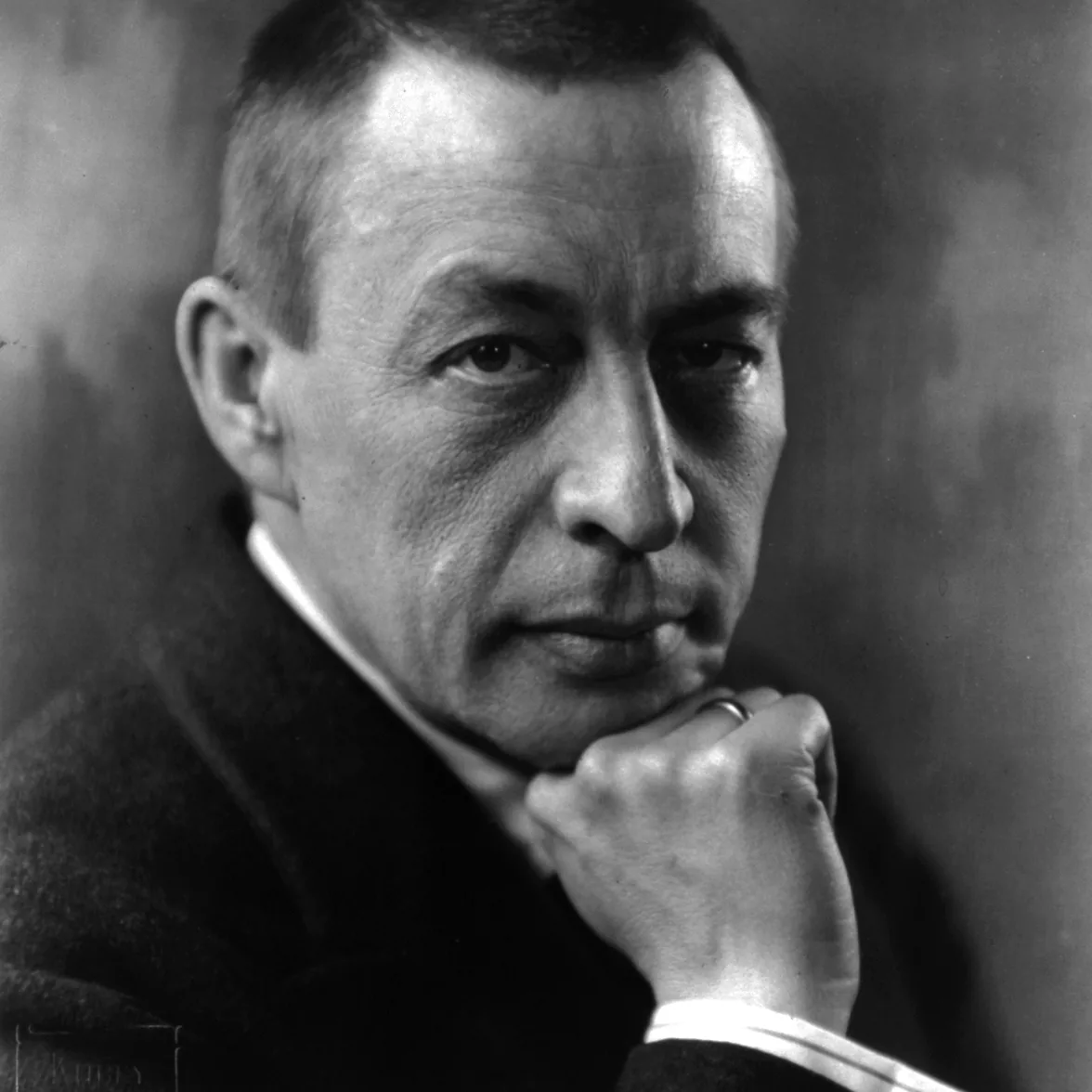
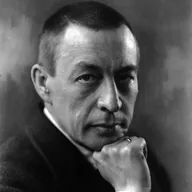
Rachmaninoff was born near Staraya Russa in 1873 and studied at the Moscow Conservatory. He conducted at the Bolshoi Theatre from 1904 to 1906, lived in Dresden from 1906 to 1909, and in 1918 settled in New York, touring as a pianist. He died in Beverly Hills in 1943. His melodies are song-like and expressive, his textures can be densely contrapuntal, and his orchestral colour is rich. He drew on Russian Orthodox chant and church bells, and Tchaikovsky and Rimsky-Korsakov were early influences. The piano is central to his output, and he wrote for it as a performer.
The failure of his First Symphony in 1897 was followed by about three years of depression and writer's block. After therapy with Dr Nikolai Dahl in 1900 he finished the Piano Concerto No. 2 in April 1901 and dedicated it to Dahl. The piano opens alone with bell-like chords, then the strings take the main theme while the piano supplies rapid arpeggios. The Prelude in C-sharp minor, Op. 3 No. 2 (1892), is an earlier bell piece, said to evoke the Kremlin chimes. Concerto No. 3 (1909) has two versions of the first-movement cadenza, one chordal and one lighter.
The Isle of the Dead (1909), after Böcklin's painting, rocks in a recurring 5/8 figure suggesting oars or waves and quotes the Dies irae chant. Symphony No. 2 (1906 to 1907) builds on a motto theme that returns across the movements; its Scherzo uses the Dies irae and its Adagio has a long clarinet solo. The Études-Tableaux (study-pictures), Op. 39, date from 1916 to 1917.
Sources: Sergei Rachmaninoff (Wikipedia), Piano Concerto No. 2 (Rachmaninoff) (Wikipedia), Piano Concerto No. 3 (Rachmaninoff) (Wikipedia), Prelude in C-sharp minor (Rachmaninoff) (Wikipedia), Isle of the Dead (Rachmaninoff) (Wikipedia), Symphony No. 2 (Rachmaninoff) (Wikipedia), Etudes-Tableaux, Op. 39 (Wikipedia)
 RachmaninoffPiano Concerto No. 1 in F-sharp minor, Op. 1RachmaninoffPrelude in C-sharp minor, Op. 3 No. 2RachmaninoffSymphony No. 1 in D minor, Op. 13RachmaninoffMoments musicaux, Op. 16RachmaninoffCello Sonata in G minor, Op. 19RachmaninoffPiano Concerto No. 2 in C minor, Op. 18RachmaninoffPrelude in G minor, Op. 23 No. 5RachmaninoffPrelude in D major, Op. 23 No. 4RachmaninoffPiano Sonata No. 1 in D minor, Op. 28RachmaninoffSymphony No. 2 in E minor, Op. 27RachmaninoffPiano Concerto No. 3 in D minor, Op. 30RachmaninoffThe Isle of the Dead, Op. 29RachmaninoffPiano Sonata No. 2 in B-flat minor, Op. 36RachmaninoffVocalise, Op. 34 No. 14RachmaninoffÉtude-Tableaux in D major, Op. 39 No. 9RachmaninoffPiano Concerto No. 4 in G minor, Op. 40RachmaninoffSymphony No. 3 in A minor, Op. 44
Path 03
Twelve slow, quiet pieces, from Chopin's lullaby to Pärt's Fratres.
Chopin → Liszt → Wagner → Debussy → Massenet → Fauré → Grainger → Delius → Vaughan Williams → Rachmaninoff → Pärt
Path 11
Soloist and orchestra across two and a half centuries, from Bach's harpsichord to Rostropovich's cello.
Bach → Vivaldi → Mozart → Beethoven → Mendelssohn → Tchaikovsky → Dvořák → Rachmaninoff → Ravel → Shostakovich
Path 12
Eleven short pieces from Field to Grieg, each holding one mood.
Field → Schubert → Mendelssohn → Chopin → Schumann → Liszt → Tchaikovsky → Rachmaninoff → Brahms → Grieg
Path 16
From Glinka to Shostakovich: a century of Russian music, in the order it was written.
Glinka → Balakirev → Mussorgsky → Borodin → Rimsky-Korsakov → Tchaikovsky → Rachmaninoff → Scriabin → Prokofiev → Shostakovich