Path 16
Russian voices
From Glinka to Shostakovich: a century of Russian music, in the order it was written.
Glinka → Balakirev → Mussorgsky → Borodin → Rimsky-Korsakov → Tchaikovsky → Rachmaninoff → Scriabin → Prokofiev → Shostakovich
1844–1908 · Romantic
1 work
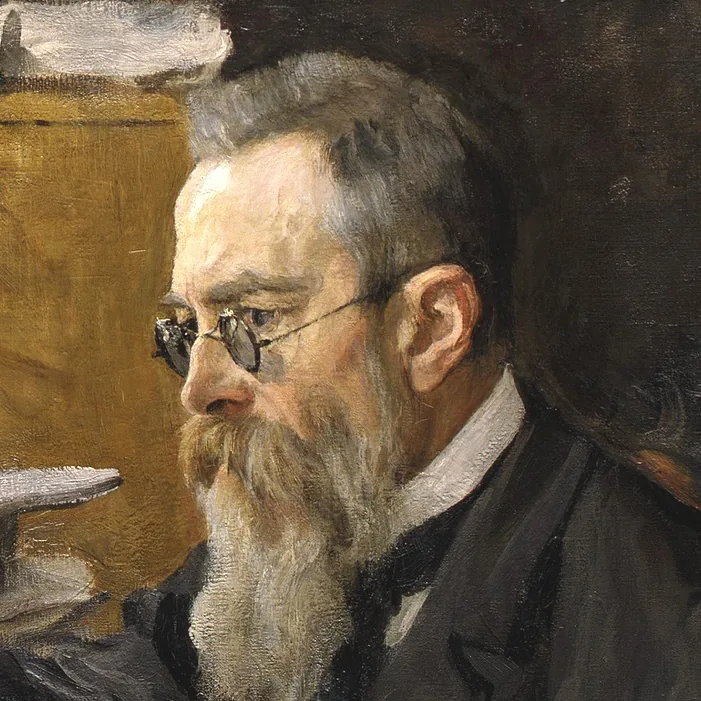
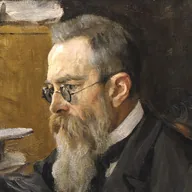
Rimsky-Korsakov was born in Tikhvin in 1844 and began as a naval officer. From 1871 he taught composition, harmony and orchestration at the Saint Petersburg Conservatory, retiring in 1906, and from 1873 he also served as civilian Inspector of Naval Bands. He was a member of The Five, the group of Russian nationalist composers, and later became the central figure of the Belyayev circle. He is known above all as a master of orchestration, and a textbook on the subject was completed after his death by his son-in-law Maximilian Steinberg.
His style is nationalist, drawing on Russian folk song and fairy-tale lore, with exotic harmony, melody and rhythm in what is called musical orientalism. In his operas he used whole-tone and octatonic scales for the fantastic scenes.
Scheherazade, Op. 35, was written between June and August 1888 and first played in Saint Petersburg on 28 October 1888 under the composer. It is a symphonic suite based on the Arabian Nights, with Scheherazade as the storyteller. The four movements are The Sea and Sinbad's Ship, The Story of the Kalendar Prince, The Young Prince and the Young Princess, and Festival at Baghdad, which ends with the ship breaking against a cliff. Rimsky-Korsakov dropped the titles in a later edition, wanting listeners to hear an oriental narrative of fairy-tale wonders. A grim bass motif for the domineering Sultan opens the first movement, and a tender, winding solo violin melody with harp accompaniment stands for Scheherazade.
Sources: Nikolai Rimsky-Korsakov (Wikipedia), Scheherazade (Rimsky-Korsakov) (Wikipedia)
Path 16
From Glinka to Shostakovich: a century of Russian music, in the order it was written.
Glinka → Balakirev → Mussorgsky → Borodin → Rimsky-Korsakov → Tchaikovsky → Rachmaninoff → Scriabin → Prokofiev → Shostakovich