Path 04
Baroque essentials
Ground bass, ritornello, fugue and dance: the Baroque in twelve works, from Purcell to Bach's Musical Offering.
Purcell → Pachelbel → Bach → Vivaldi → Handel → Scarlatti
1685–1757 · Baroque
1 work
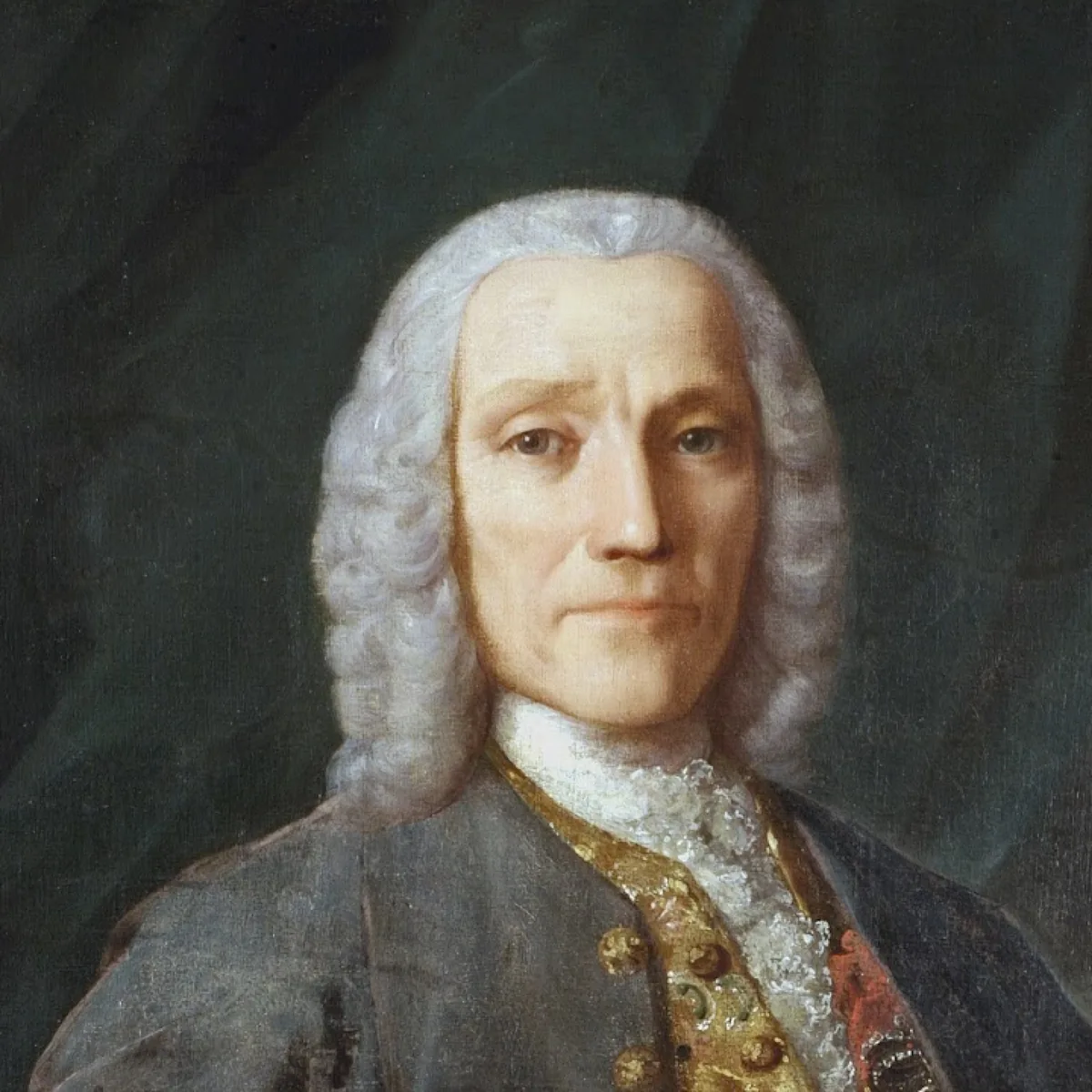
Scarlatti was born in Naples, the son of the opera composer Alessandro Scarlatti. He worked in Rome, then in Lisbon from 1719 as music director to King John V of Portugal. When the Portuguese princess Maria Barbara went to Spain, he followed her to Seville in 1729 and to Madrid in 1733. Most of his keyboard sonatas were written for her.
He left about 555 sonatas, nearly all in one movement and mostly in two-part (binary) form: a first half that leaves the home key and a second half that answers it. Each half is repeated. Thirty of them appeared in print as the Essercizi in 1738, apparently under his supervision, but most went unpublished in his lifetime. Iberian folk music shaped the style: guitar-like strumming and repeated notes, the Phrygian mode, bold dissonance, and sudden modulations to distant keys. The K. numbers come from Ralph Kirkpatrick's 1953 catalogue and are now standard; the older L. numbers belong to Alessandro Longo's edition.
Sonata K. 141 in D minor (L. 422) is a fast piece in 3/8 built on rapid repeated notes, so the keyboard sounds like a plucked instrument. It uses hand crossing, trills and syncopated rhythms drawn from Spanish dance music. Some players call it a toccata because it displays finger technique. It is a single movement in binary form, as is typical of the sonatas.
Sources: Domenico Scarlatti (Wikipedia), Keyboard Sonata, K. 141 (Scarlatti) (Wikipedia)
Path 04
Ground bass, ritornello, fugue and dance: the Baroque in twelve works, from Purcell to Bach's Musical Offering.
Purcell → Pachelbel → Bach → Vivaldi → Handel → Scarlatti
Path 09
One work for each kind in the catalog, from the symphony to choral music.
Beethoven → Vivaldi → Debussy → Holst → Dvořák → Mozart → Chopin → Scarlatti → Bach → Schubert → Strauss → Handel