Path 13
The art song, from Schubert to Strauss
A poem, a voice and a piano, later an orchestra: from Schubert's first masterpieces to Strauss's last songs.
Schubert → Schumann → Wagner → Mahler → Debussy → Fauré → Strauss
1797–1828 · Classical to early Romantic
28 works
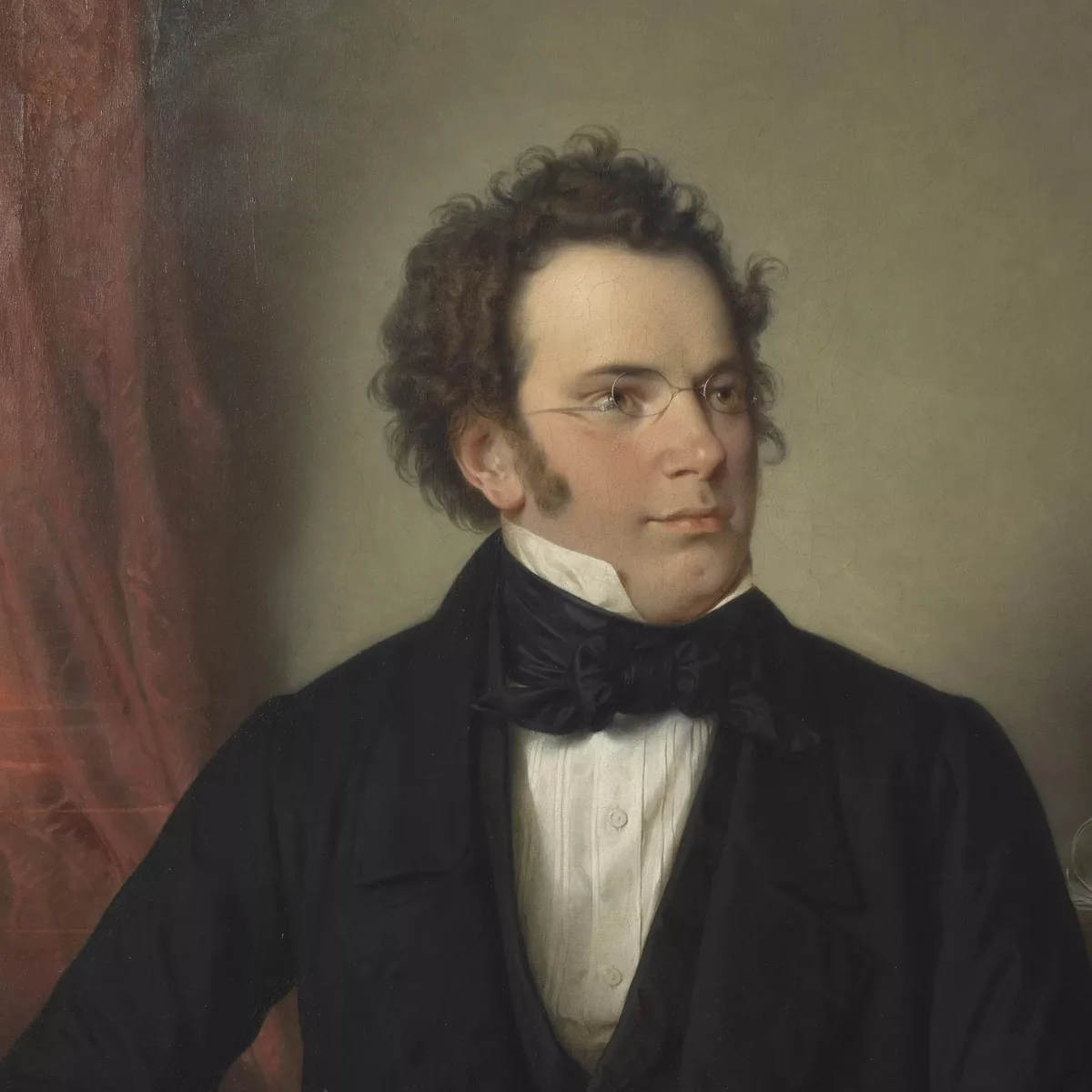
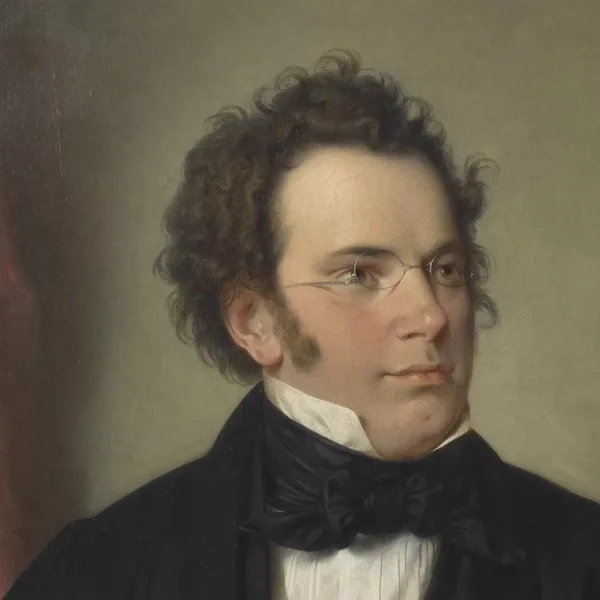
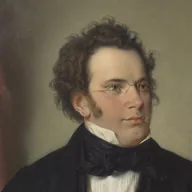
Schubert was born in Vienna and died there at thirty-one, having written more than a thousand works, including over six hundred songs. Much of his music was first heard at gatherings of friends called Schubertiads, where the baritone Johann Michael Vogl became a champion of his songs. He joined the sonata forms of Haydn, Mozart and Beethoven to long, singing melody. Schumann praised the "heavenly length" of his Ninth Symphony.
His harmony turns on sudden, distant key changes. In the B-flat Sonata, D. 960, the second theme of the first movement enters in F-sharp minor, far from the home key. Major and minor alternate inside one piece, as in the F minor Fantasia for four hands. In his songs the piano paints the scene: a spinning wheel in Gretchen am Spinnrade (written at seventeen), galloping triplets in Erlkönig, a rippling brook in Die schöne Müllerin. Winterreise sets twenty-four poems by Wilhelm Müller.
Several instrumental works grow from his own songs. The slow movement of Death and the Maiden is a theme and five variations on a song, and every movement of the Wanderer Fantasy starts from a variant of a phrase of Der Wanderer. The catalog also includes the Impromptus and Moments musicaux, the last three sonatas of 1828, the Arpeggione Sonata (written for a bowed guitar), the Quartettsatz, and three symphonies: the small-scale Fifth, the two-movement Unfinished, and the "Great" C major.
Sources: Franz Schubert (Wikipedia), Piano Sonata No. 21 (Schubert) (Wikipedia), Wanderer Fantasy (Wikipedia), String Quartet No. 14 (Schubert) (Wikipedia), Symphony No. 5 (Schubert) (Wikipedia), Gretchen am Spinnrade (Wikipedia), Erlkönig (Schubert) (Wikipedia), Winterreise (Wikipedia), Die schöne Müllerin (Wikipedia), Fantasia in F minor (Schubert) (Wikipedia)
 SchubertGretchen am Spinnrade, D 118; Op. 2SchubertErlkönig, D 328; Op. 1SchubertSymphony No. 5 in B-flat major, D 485SchubertPiano Sonata in A minor, D. 537SchubertPiano Sonata in A major, D. 664SchubertQuartettsatz in C minor, D. 703SchubertSymphony No. 8 in B minor, D 759SchubertWanderer Fantasy in C major, D 760; Op. 15SchubertDie schöne Müllerin, D. 795SchubertPiano Sonata in A minor, D. 784SchubertArpeggione Sonata in A minor, D. 821SchubertString Quartet No. 14 in D minor, D. 810FreeSchubertPiano Sonata in A minor, D. 845SchubertPiano Sonata in D major, D. 850SchubertPiano Sonata in G major, D. 894SchubertSymphony No. 9 in C major, D. 944SchubertFour Impromptus, D. 935SchubertImpromptu No. 1 in C minor, D. 899/1; Op. 90 No. 1SchubertImpromptu No. 2 in E-flat major, D. 899/2; Op. 90 No. 2SchubertImpromptu No. 3 in G-flat major, D 899 / Op. 90 No. 3SchubertImpromptu No. 4 in A-flat major, D. 899/4; Op. 90 No. 4SchubertSix Moments musicaux, D. 780SchubertWinterreise, D. 911SchubertFantasia in F minor for piano four hands, D. 940SchubertPiano Sonata in A major, D. 959SchubertPiano Sonata in C minor, D. 958SchubertPiano Sonata No. 21 in B-flat major, D. 960SchubertThree Piano Pieces (Drei Klavierstücke), D. 946
Path 13
A poem, a voice and a piano, later an orchestra: from Schubert's first masterpieces to Strauss's last songs.
Schubert → Schumann → Wagner → Mahler → Debussy → Fauré → Strauss
Path 01
Ten well-known works to learn the map on, each open in full to everyone.
Pachelbel → Bach → Vivaldi → Mozart → Beethoven → Schubert → Chopin → Dvořák → Debussy
Path 02
Twelve symphonies from Mozart's Fortieth to Shostakovich's Fifth, the core of the concert repertoire.
Mozart → Haydn → Beethoven → Schubert → Berlioz → Mendelssohn → Brahms → Mahler → Tchaikovsky → Dvořák → Shostakovich
Path 05
The form behind most first movements, heard twelve times, from a small sonata to a symphony.
Mozart → Haydn → Beethoven → Schubert → Mendelssohn → Brahms → Prokofiev
Path 07
Short, complete works for a single sitting.
Bach → Mozart → Haydn → Beethoven → Schubert → Mendelssohn → Saint-Saëns → Sibelius → Ravel → Debussy → Gershwin → Copland
Path 08
Four players across almost two centuries: Haydn shapes the conversation, Bartók breaks it open, Shostakovich turns it inward.
Haydn → Mozart → Schubert → Beethoven → Dvořák → Debussy → Reger → Bartók → Shostakovich