Path 13
The art song, from Schubert to Strauss
A poem, a voice and a piano, later an orchestra: from Schubert's first masterpieces to Strauss's last songs.
Schubert → Schumann → Wagner → Mahler → Debussy → Fauré → Strauss
1810–1856 · Romantic
32 works
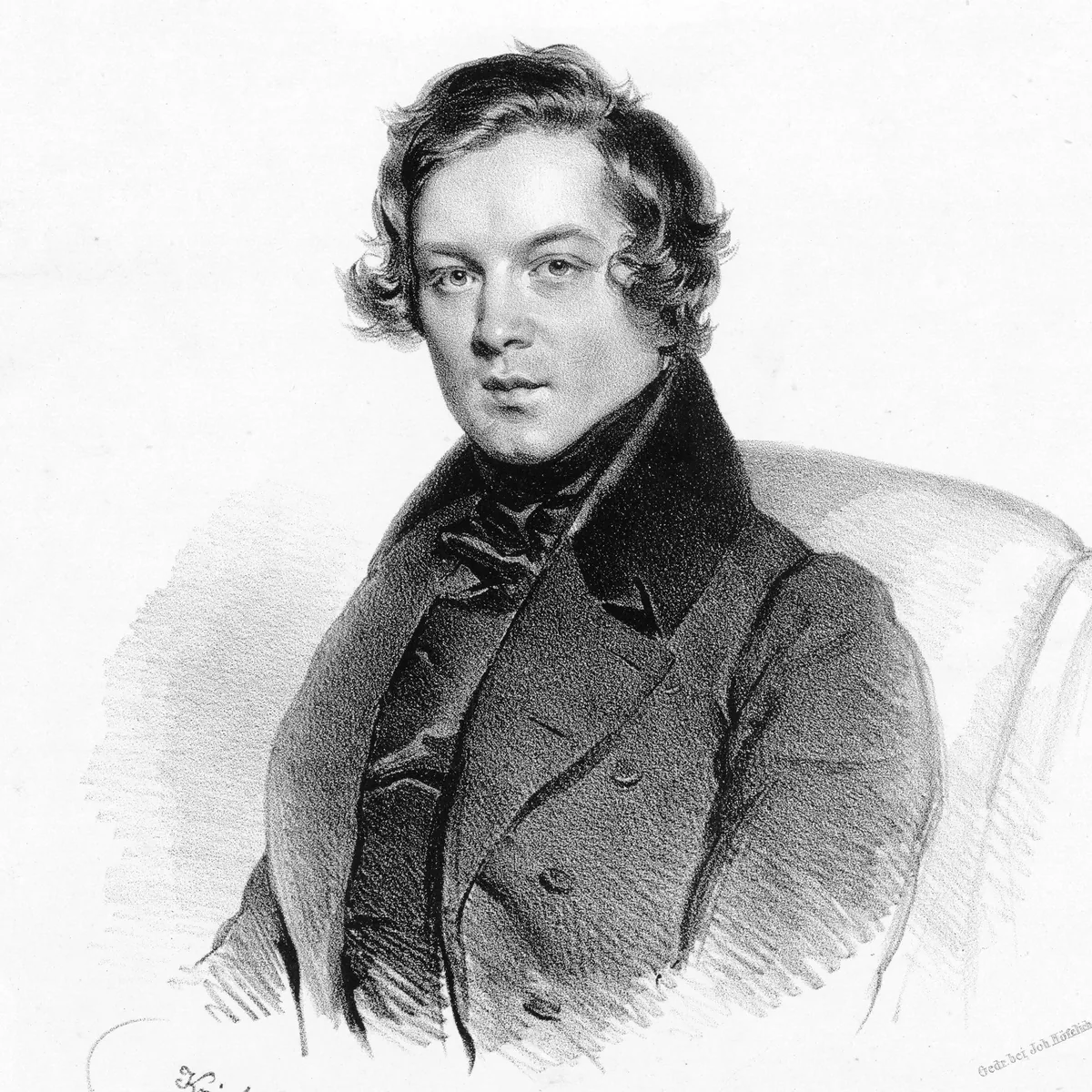
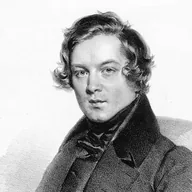
Schumann was born in Zwickau and worked in Leipzig and, from 1850, Düsseldorf. His output falls into phases. In the 1830s he wrote almost only for the piano, mostly in cycles of short pieces with titles, hidden letters or literary characters: Carnaval, Kreisleriana, Kinderszenen, Davidsbündlertänze. In 1840 he wrote more than half of his songs, among them Dichterliebe, Frauenliebe und -leben and the twelve Eichendorff settings of Liederkreis, Op. 39. In 1841 and 1842 he turned to the symphony and to chamber music, and in 1849 and 1851 he wrote pieces pairing one instrument with piano: the Fantasiestücke for clarinet, the Märchenbilder for viola, and the violin sonatas.
Two alter egos appear in his writing: Florestan, impetuous, and Eusebius, dreamy. Carnaval is built on four-note motifs that spell a town name and Schumann's own letters, and it is known for full chordal passages and rhythmic displacement. The oboe theme in the first movement of the Piano Concerto spells Clara's name (C, H, A, A). In the songs, voice and piano are equal partners, and the piano postlude often sums up the song.
His orchestral music keeps the piano composer's habits, with doubled parts that fill the middle of the sound, and conductors still debate whether to lighten them. The Fourth Symphony runs its movements without a pause and brings the slow introduction back in the second movement. The Third (Rhenish) has five movements; the fourth evokes a ceremony in Cologne Cathedral. The Piano Quintet of 1842 set the pattern for piano plus string quartet.
Sources: Robert Schumann (Wikipedia), List of compositions by Robert Schumann (Wikipedia), Carnaval (Schumann) (Wikipedia), Piano Concerto (Schumann) (Wikipedia), Frauenliebe und -leben (Wikipedia), Symphony No. 4 (Schumann) (Wikipedia), Symphony No. 3 (Schumann) (Wikipedia), Piano Quintet (Schumann) (Wikipedia), Davidsbündlertänze (Wikipedia), Liederkreis, Op. 39 (Schumann) (Wikipedia)
 SchumannAbegg Variations, Op. 1SchumannToccata in C major, Op. 7SchumannCarnaval, Op. 9SchumannPiano Sonata No. 1 in F-sharp minor, Op. 11SchumannPiano Sonata No. 2 in G minor, Op. 22SchumannFantasie in C major, Op. 17SchumannDavidsbündlertänze, Op. 6SchumannKinderszenen, Op. 15SchumannKreisleriana, Op. 16SchumannArabeske in C major, Op. 18SchumannHumoreske in B-flat major, Op. 20SchumannNachtstücke, Op. 23SchumannDichterliebe, Op. 48FreeSchumannFaschingsschwank aus Wien, Op. 26SchumannFrauenliebe und -leben, Op. 42SchumannLiederkreis, Op. 39SchumannSymphony No. 1 in B-flat major, Op. 38SchumannPiano Quintet in E-flat major, Op. 44SchumannString Quartet No. 3 in A major, Op. 41 No. 3SchumannPiano Concerto in A minor, Op. 54SchumannSymphony No. 2 in C major, Op. 61SchumannAlbum for the Young: No. 7, Op. 68 No. 7SchumannAlbum for the Young: No. 16, Op. 68 No. 16SchumannAdagio and Allegro, Op. 70SchumannFantasiestücke (Fantasy Pieces) for Clarinet and Piano, Op. 73SchumannIntroduction and Allegro appassionato, Op. 92SchumannWaldszenen, Op. 82SchumannSymphony No. 3 in E-flat major, Op. 97SchumannMärchenbilder, Op. 113SchumannSymphony No. 4 in D minor, Op. 120SchumannViolin Sonata No. 1 in A minor, Op. 105SchumannViolin Sonata No. 2 in D minor, Op. 121
Path 13
A poem, a voice and a piano, later an orchestra: from Schubert's first masterpieces to Strauss's last songs.
Schubert → Schumann → Wagner → Mahler → Debussy → Fauré → Strauss
Path 12
Eleven short pieces from Field to Grieg, each holding one mood.
Field → Schubert → Mendelssohn → Chopin → Schumann → Liszt → Tchaikovsky → Rachmaninoff → Brahms → Grieg