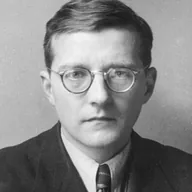
Shostakovich built his career in the Soviet Union, where music could bring official praise or official attack. In 1936 the newspaper Pravda condemned his opera Lady Macbeth of Mtsensk; his Fifth Symphony (1937), more conservative in manner, was a great success at its Leningrad premiere. He was denounced again in 1948. He left fifteen symphonies and fifteen string quartets, the quartets mostly from his later years.
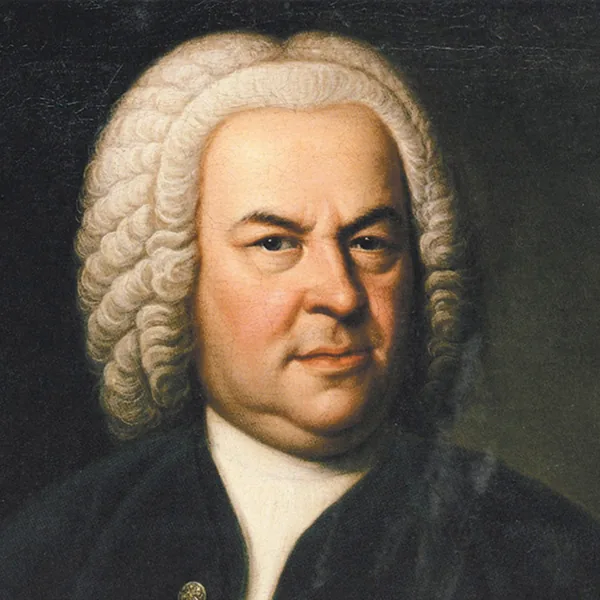
His music is mostly tonal but often ambivalent. It swings sharply between moods and uses sarcasm and the grotesque, with Bach's fugues and passacaglias, late Beethoven quartets and Mahler's symphonies behind it. From the 1940s he drew on Jewish folk melody. He quoted himself often and signed some works with a four-note motif, D, E-flat, C, B (DSCH in German note names). In the late chamber works he used twelve-tone rows, but as themes rather than as a strict system.
The catalog shows the range. Quartet No. 1 (1938) is short and light, and he described it as bright scenes of childhood and spring. No. 3 has five movements that once carried programme titles, from "Blithe ignorance of the future cataclysm" to "The eternal question: why? and for what?". No. 7 is his shortest and No. 8, written in three days in Dresden in 1960, is full of self-quotation. The Piano Concerto No. 2 was a cheerful piece for his son's graduation; the Cello Concerto No. 1 was written for Mstislav Rostropovich. The Viola Sonata, finished weeks before his death in 1975, is his last work.
What to listen for
- In Quartet No. 8, the DSCH motif opens the first movement and returns in every movement, with quotations from his earlier works.
- In Symphony No. 5, the Largo uses no brass: divided strings and an oboe carry the music, and the finale moves from D minor to a loud D major.
- In Cello Concerto No. 1, a four-note motto that returns in every movement but the second, only one horn in the orchestra, and a cadenza that forms a movement of its own.
- In Piano Concerto No. 2, a light finale with a theme in 7/8 and a section that parodies piano finger exercises.
- In the Viola Sonata, a bare opening of unaccompanied plucked viola, and an Adagio that hints at Beethoven's Moonlight Sonata.
Sources: Dmitri Shostakovich (Wikipedia), String Quartet No. 8 (Shostakovich) (Wikipedia), String Quartet No. 7 (Shostakovich) (Wikipedia), String Quartet No. 3 (Shostakovich) (Wikipedia), String Quartet No. 1 (Shostakovich) (Wikipedia), Symphony No. 5 (Shostakovich) (Wikipedia), Cello Concerto No. 1 (Shostakovich) (Wikipedia), Piano Concerto No. 2 (Shostakovich) (Wikipedia), Viola Sonata (Shostakovich) (Wikipedia)