Path 03
Calm classical music
Twelve slow, quiet pieces, from Chopin's lullaby to Pärt's Fratres.
Chopin → Liszt → Wagner → Debussy → Massenet → Fauré → Grainger → Delius → Vaughan Williams → Rachmaninoff → Pärt
1813–1883 · Romantic
10 works

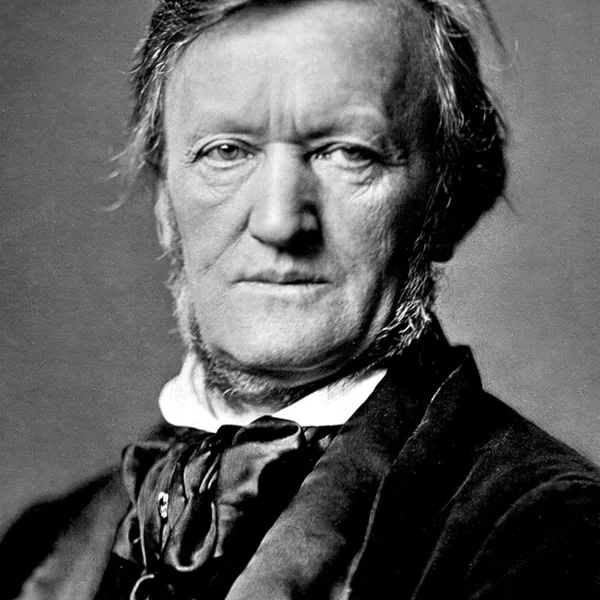
Wagner, born in Leipzig, wrote the librettos as well as the music for all his stage works, which he called poems. He aimed at a Gesamtkunstwerk, a total work of art uniting drama, music and staging. He built his own theatre at Bayreuth, opened in 1876 with the Ring, with the orchestra in a pit hidden from the audience. In his later operas the orchestra is as important as the singers. His main tool is the leitmotif, a phrase tied to a character, place or idea, which returns and changes as the drama develops.
The overtures and preludes in the catalog show his path. The Rienzi overture (opera of 1842) follows French grand opera, opening with a trumpet call and ending with a march. In Der fliegende Holländer and Tannhäuser the overtures preview the opera's main themes: the ocean-storm motif, the Pilgrims' Chorus. The Lohengrin Prelude is a single long crescendo and fade. Tristan und Isolde opens with the Tristan chord, a dissonance that resolves into another dissonance, so the tension is held until Act 3. The Parsifal Prelude introduces the Communion and Grail themes, the Grail being represented by the Dresden Amen.
Two works step outside the opera house. The Wesendonck Lieder (1857 to 1858) set poems by Mathilde Wesendonck; Wagner called two of them, Im Treibhaus and Träume, studies for Tristan. The Siegfried Idyll was played on Christmas morning 1870 as a birthday gift for his wife Cosima, and its main melody later reappears in the love duet of Brünnhilde and Siegfried. The Ride of the Valkyries opens Act 3 of Die Walküre, the orchestra carrying the tune while the Valkyries call above it.
Sources: Richard Wagner (Wikipedia), Tristan und Isolde (Wikipedia), Wesendonck Lieder (Wikipedia), Siegfried Idyll (Wikipedia), Rienzi (Wikipedia), Der fliegende Holländer (Wikipedia), Tannhäuser (opera) (Wikipedia), Ride of the Valkyries (Wikipedia), Parsifal (Wikipedia), Die Meistersinger von Nürnberg (Wikipedia), Programme notes: Die Meistersinger, Prelude to Act 1 (Berliner Philharmoniker), Prelude to Act I of Lohengrin (Hollywood Bowl program notes)
 WagnerRienzi Overture, WWV 49WagnerDer fliegende Holländer OvertureWagnerTannhäuser Overture, WWV 70WagnerLohengrin: Prelude to Act IWagnerDie Walküre: Ride of the ValkyriesWagnerWesendonck LiederWagnerTristan und Isolde: VorspielWagnerDie Meistersinger von Nürnberg: Prelude to Act IWagnerSiegfried Idyll, WWV 103WagnerParsifal: Prelude to Act I
Path 03
Twelve slow, quiet pieces, from Chopin's lullaby to Pärt's Fratres.
Chopin → Liszt → Wagner → Debussy → Massenet → Fauré → Grainger → Delius → Vaughan Williams → Rachmaninoff → Pärt
Path 13
A poem, a voice and a piano, later an orchestra: from Schubert's first masterpieces to Strauss's last songs.
Schubert → Schumann → Wagner → Mahler → Debussy → Fauré → Strauss
Path 26
Twelve overtures from Mozart's Figaro to Bernstein's Candide, each a complete piece in a few minutes.
Mozart → Beethoven → Rossini → Weber → Mendelssohn → Wagner → Berlioz → Offenbach → Brahms → Tchaikovsky → Bernstein