Path 01
Start here
Ten well-known works to learn the map on, each open in full to everyone.
Pachelbel → Bach → Vivaldi → Mozart → Beethoven → Schubert → Chopin → Dvořák → Debussy
Listening paths · Path 06
Haydn's two London visits, 1791–95: six of the symphonies he wrote there, three piano sonatas, and what he took home to Vienna.
Haydn travelled to London twice, in 1791–92 and 1794–95, and wrote twelve symphonies for its concerts. Six are here: the Surprise from the first visit and the last five from the second. Each opens with a slow introduction, and each plays with what its audience expected to hear next. In London he also wrote piano sonatas for the bigger English instruments, and he went home with ideas that shaped his last years in Vienna: an anthem in the manner of “God Save the King”, and an oratorio in the line of the Handel he had heard there.
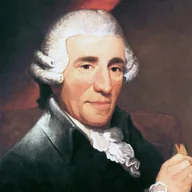 HaydnSymphony No. 94 in G major, Hob. I:94
Written during the first visit and first played at the Hanover Square Rooms in March 1792, with Haydn at the fortepiano. The surprise comes in the Andante: a soft tune, repeated even more softly, then one loud chord from the whole orchestra.
HaydnSymphony No. 100 in G majorThe “Military”: triangle, cymbals and bass drum join in the second movement, and a trumpet call sounds near its end.
HaydnSymphony No. 101 in D majorThe “Clock”: in the second movement bassoons and plucked strings tick under the melody.
HaydnSymphony No. 102 in B-flat majorNo nickname of its own. The story of a chandelier that fell at a premiere without hurting anyone belongs to this work, but the name “Miracle” went to No. 96.
HaydnSymphony No. 103 in E-flat majorIt begins with a roll on the timpani alone, and the slow opening returns near the end of the first movement.
HaydnSymphony No. 104 in D majorHaydn's last symphony. The finale's tune sits over a long held bass note, like a drone under a folk song.
HaydnPiano Sonata in E-flat major, Hob. XVI:52Haydn’s last piano sonata, composed in London in 1794 for the pianist Therese Jansen. Its massive chords and full textures suit the bigger sound of the English pianos he came to know there.
HaydnPiano Sonata in C major, Hob. XVI:50Another sonata for Therese Jansen, from the second stay. The Allegro builds its theme from single notes up to full rolled chords, and the marking “open Pedal” asks for a deliberate blur of sound – something new, written for English instruments.
HaydnPiano Sonata in D major, Hob. XVI:51Probably written during the second London stay, but unlike its two neighbours it has no link to Therese Jansen. It is smaller in scale: an Andante whose exposition is not repeated, then a quick rondo in three-four time.
HaydnString Quartet in C major, Op. 76 No. 3Back in Vienna, Haydn remembered how the English sang loyalty to their king, and wrote an anthem of his own, “Gott erhalte Franz den Kaiser”. The slow movement takes it as its Theme: four variations in which the tune barely changes while everything around it does.
HaydnThe Creation: OvertureLondon gave Haydn the Handel oratorios and, probably through Salomon, an English libretto; The Creation, finished in Vienna, was the result. Its overture paints the world before creation: muted strings, quiet dynamics and harmony that never comes to rest.
Path 01
Ten well-known works to learn the map on, each open in full to everyone.
Pachelbel → Bach → Vivaldi → Mozart → Beethoven → Schubert → Chopin → Dvořák → Debussy
Path 02
Twelve symphonies from Mozart's Fortieth to Shostakovich's Fifth, the core of the concert repertoire.
Mozart → Haydn → Beethoven → Schubert → Berlioz → Mendelssohn → Brahms → Mahler → Tchaikovsky → Dvořák → Shostakovich
Path 03
Twelve slow, quiet pieces, from Chopin's lullaby to Pärt's Fratres.
Chopin → Liszt → Wagner → Debussy → Massenet → Fauré → Grainger → Delius → Vaughan Williams → Rachmaninoff → Pärt
Path 04
Ground bass, ritornello, fugue and dance: the Baroque in twelve works, from Purcell to Bach's Musical Offering.
Purcell → Pachelbel → Bach → Vivaldi → Handel → Scarlatti
Path 05
The form behind most first movements, heard twelve times, from a small sonata to a symphony.
Mozart → Haydn → Beethoven → Schubert → Mendelssohn → Brahms → Prokofiev
Path 07
Short, complete works for a single sitting.
Bach → Mozart → Haydn → Beethoven → Schubert → Mendelssohn → Saint-Saëns → Sibelius → Ravel → Debussy → Gershwin → Copland
Path 08
Four players across almost two centuries: Haydn shapes the conversation, Bartók breaks it open, Shostakovich turns it inward.
Haydn → Mozart → Schubert → Beethoven → Dvořák → Debussy → Reger → Bartók → Shostakovich
Path 09
One work for each kind in the catalog, from the symphony to choral music.
Beethoven → Vivaldi → Debussy → Holst → Dvořák → Mozart → Chopin → Scarlatti → Bach → Schubert → Strauss → Handel
Path 10
From the First of 1800 to the Choral of 1824, in the order Beethoven wrote them.
Beethoven
Path 11
Soloist and orchestra across two and a half centuries, from Bach's harpsichord to Rostropovich's cello.
Bach → Vivaldi → Mozart → Beethoven → Mendelssohn → Tchaikovsky → Dvořák → Rachmaninoff → Ravel → Shostakovich
Path 12
Eleven short pieces from Field to Grieg, each holding one mood.
Field → Schubert → Mendelssohn → Chopin → Schumann → Liszt → Tchaikovsky → Rachmaninoff → Brahms → Grieg
Path 13
A poem, a voice and a piano, later an orchestra: from Schubert's first masterpieces to Strauss's last songs.
Schubert → Schumann → Wagner → Mahler → Debussy → Fauré → Strauss
Path 14
Two ways of making much from little: a theme changed again and again, and a subject passed from voice to voice.
Bach → Mozart → Haydn → Beethoven → Mendelssohn → Brahms → Elgar
Path 15
Fauré, Satie, Debussy, Chausson, Dukas and Ravel, from 1887 to 1920.
Fauré → Satie → Debussy → Chausson → Dukas → Ravel
Path 16
From Glinka to Shostakovich: a century of Russian music, in the order it was written.
Glinka → Balakirev → Mussorgsky → Borodin → Rimsky-Korsakov → Tchaikovsky → Rachmaninoff → Scriabin → Prokofiev → Shostakovich
Path 17
Nocturne, étude, mazurka, scherzo, ballade, polonaise, waltz: Chopin's genres in twelve works, in the order he wrote them.
Chopin
Path 18
Mozart in twelve works, from a motet written at sixteen to the Requiem he left unfinished.
Mozart
Path 19
Brahms in twelve works, from the First Piano Concerto to the last of his piano pieces.
Brahms
Path 20
Twelve piano sonatas from Mozart and Haydn to Prokofiev's war sonata of 1942.
Mozart → Haydn → Beethoven → Schubert → Chopin → Liszt → Berg → Bartók → Prokofiev
Path 21
Two French composers side by side, often compared and often confused, from 1891 to Boléro in 1928.
Debussy → Ravel
Path 22
Ten violin concertos, from Beethoven's of 1806 to Sibelius's of 1904.
Beethoven → Paganini → Mendelssohn → Wieniawski → Bruch → Lalo → Brahms → Tchaikovsky → Dvořák → Sibelius
Path 23
The late Romantic orchestra at its largest: Bruckner's and Mahler's symphonies and Strauss's tone poems, 1880 to 1945.
Bruckner → Mahler → Strauss
Path 24
Folk songs, dances and landscapes, from Liszt's Hungary to Márquez's Mexico.
Liszt → Smetana → Grieg → Albéniz → Dvořák → Sibelius → Elgar → Vaughan Williams → Janáček → Villa-Lobos → Rodrigo → Márquez
Path 25
Choirs from Handel's coronation anthem to Ligeti's cloud of voices: masses, requiems and psalms, 1727 to 1966.
Handel → Mozart → Brahms → Verdi → Fauré → Orff → Messiaen → Bernstein → Ligeti
Path 26
Twelve overtures from Mozart's Figaro to Bernstein's Candide, each a complete piece in a few minutes.
Mozart → Beethoven → Rossini → Weber → Mendelssohn → Wagner → Berlioz → Offenbach → Brahms → Tchaikovsky → Bernstein
Path 27
Twelve directions the century took, from Schoenberg's Verklärte Nacht of 1899 to Piazzolla's tango of 1982.
Schoenberg → Ives → Bartók → Holst → Gershwin → Barber → Prokofiev → Copland → Ligeti → Górecki → Piazzolla
Path 28
A prelude and fugue in every major and minor key: Book I complete, then eleven pairs from Book II.
Bach