Path 06
Haydn in London
Haydn's two London visits, 1791–95: six of the symphonies he wrote there, three piano sonatas, and what he took home to Vienna.
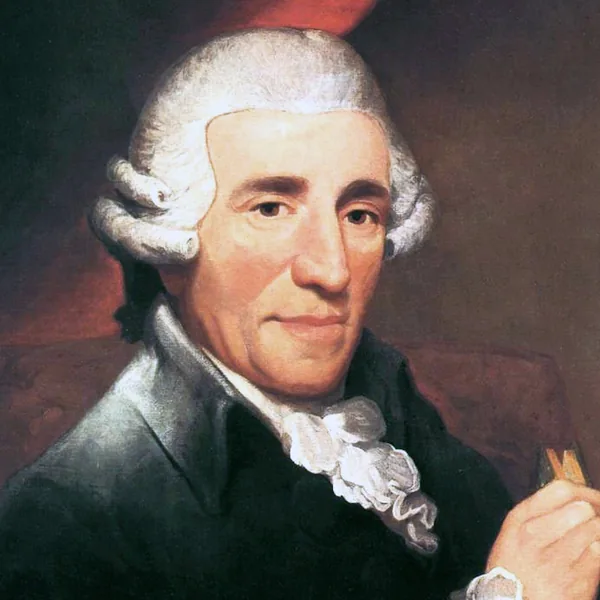
Haydn
1732–1809 · Classical
44 works
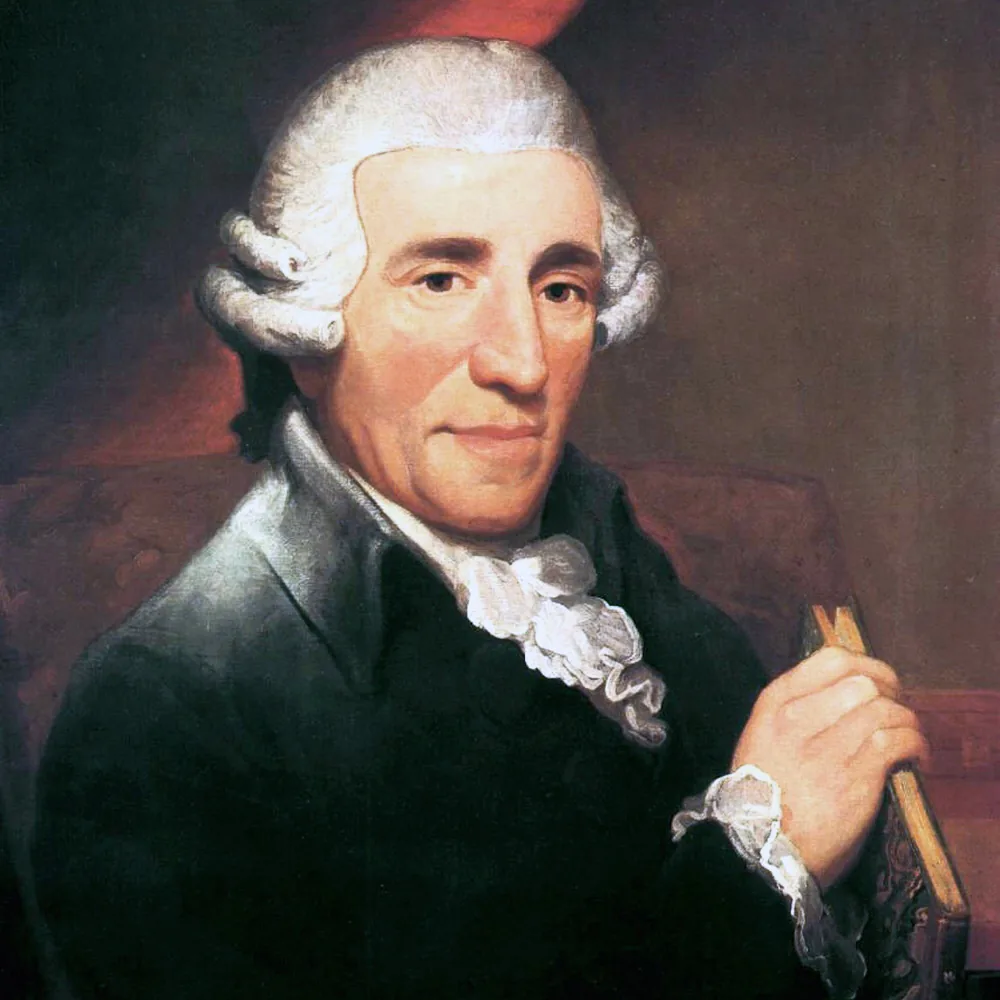
Haydn was born in Rohrau in 1732 and died in Vienna in 1809. After singing in the choir of St Stephen's Cathedral he worked for Count Morzin from 1757 and then for the Esterházy family from 1761 to 1790. Two visits to London for the impresario Johann Peter Salomon (1791 to 1792 and 1794 to 1795) brought him wide fame. He is called the father of the symphony and of the string quartet, and his music builds large structures from short motifs, with a well-known streak of humour.
The catalog follows him across that career. Symphony No. 1 dates from 1759. Nos. 44 and 45 (1772) are minor-key works from his stormy Sturm und Drang period, and No. 45 ends with the players leaving one by one. Nos. 82 and 87 belong to the Paris set written for the Concert de la Loge Olympique (1785 to 1786), and No. 88 followed in 1787. The London symphonies, Nos. 94 to 104, all open with a slow introduction except No. 95, and several nicknames name a sound: the loud chord of the Surprise, the percussion of the Military, the ticking of the Clock, the drum roll of No. 103.
His chamber writing changes visibly. In the Op. 20 quartets (1772) the cello gets a far larger role and three finales are fugues. He called Op. 33 (1781) a new and entirely special kind, with a scherzo in place of the minuet. Op. 76 (1797 or 1798) uses forms as unusual as a canon and a fantasia. The piano sonatas run from the C minor work of 1771 to the E-flat sonata written in London in 1794. The concertos for cello, horn and trumpet add solo voices, and the overture to The Creation (1798) depicts chaos in a slow C minor that withholds cadences, so its phrases never settle.
Sources: Joseph Haydn (Wikipedia), London symphonies (Wikipedia), Symphony No. 1 (Haydn) (Wikipedia), Symphony No. 44 (Haydn) (Wikipedia), Symphony No. 45 (Haydn) (Wikipedia), Symphony No. 82 (Haydn) (Wikipedia), Symphony No. 87 (Haydn) (Wikipedia), Symphony No. 88 (Haydn) (Wikipedia), Symphony No. 94 (Haydn) (Wikipedia), Symphony No. 99 (Haydn) (Wikipedia), Symphony No. 100 (Haydn) (Wikipedia), Symphony No. 101 (Haydn) (Wikipedia), Symphony No. 103 (Haydn) (Wikipedia), String Quartets, Op. 20 (Haydn) (Wikipedia), String Quartets, Op. 33 (Haydn) (Wikipedia), String Quartets, Op. 76 (Haydn) (Wikipedia), List of solo piano compositions by Joseph Haydn (Wikipedia), Piano Sonata Hob. XVI/52 (Wikipedia), Trumpet Concerto (Haydn) (Wikipedia), The Creation (Haydn) (Wikipedia)
 HaydnSymphony No. 1 in D major, Hob. I:1HaydnHorn Concerto in D major, Hob. VIId:3HaydnCello Concerto No. 1 in C major, Hob. VIIb:1HaydnPiano Sonata in A-flat major, Hob. XVI:46HaydnPiano Sonata in C minor, Hob. XVI:20HaydnString Quartet in A major, Op. 20 No. 6HaydnString Quartet in C major, Op. 20 No. 2HaydnString Quartet in D major, Op. 20 No. 4HaydnString Quartet in E-flat major, Op. 20 No. 1HaydnString Quartet in F minor, Op. 20 No. 5HaydnString Quartet in G minor, Op. 20 No. 3HaydnSymphony No. 44 in E minor, Hob. I:44HaydnSymphony No. 45 in F-sharp minor, Hob. I:45HaydnPiano Sonata in F major, Hob. XVI:23HaydnPiano Sonata in E minor, Hob. XVI:34HaydnPiano Sonata in C major, Hob. XVI:35HaydnPiano Sonata in D major, Hob. XVI:37HaydnString Quartet in B minor, Op. 33 No. 1HaydnString Quartet in C major, Op. 33 No. 3HaydnString Quartet in E-flat major, Op. 33 No. 2HaydnString Quartet in G major, Op. 33 No. 5HaydnSymphony No. 81 in G major, Hob. I:81HaydnSymphony No. 87 in A major, Hob. I:87HaydnSymphony No. 82 in C major, Hob. I:82HaydnSymphony No. 88 in G major, Hob. I:88HaydnPiano Sonata in C major, Hob. XVI:48HaydnPiano Sonata in E-flat major, Hob. XVI:49HaydnString Quartet in D major, Op. 64 No. 5HaydnString Quartet in E-flat major, Op. 64 No. 6HaydnSymphony No. 94 in G major, Hob. I:94HaydnAndante with Variations in F minor, Hob. XVII:6HaydnPiano Sonata in D major, Hob. XVI:51HaydnPiano Sonata in E-flat major, Hob. XVI:52HaydnSymphony No. 100 in G majorHaydnSymphony No. 101 in D majorHaydnSymphony No. 102 in B-flat majorHaydnPiano Sonata in C major, Hob. XVI:50HaydnSymphony No. 103 in E-flat majorHaydnSymphony No. 104 in D majorFreeHaydnTrumpet Concerto in E-flat major, Hob. VIIe:1HaydnString Quartet in C major, Op. 76 No. 3HaydnString Quartet in D minor, Op. 76 No. 2HaydnString Quartet in G major, Op. 76 No. 1HaydnThe Creation: Overture
Path 06
Haydn's two London visits, 1791–95: six of the symphonies he wrote there, three piano sonatas, and what he took home to Vienna.
Haydn
Path 08
Four players across almost two centuries: Haydn shapes the conversation, Bartók breaks it open, Shostakovich turns it inward.
Haydn → Mozart → Schubert → Beethoven → Dvořák → Debussy → Reger → Bartók → Shostakovich
Path 02
Twelve symphonies from Mozart's Fortieth to Shostakovich's Fifth, the core of the concert repertoire.
Mozart → Haydn → Beethoven → Schubert → Berlioz → Mendelssohn → Brahms → Mahler → Tchaikovsky → Dvořák → Shostakovich
Path 05
The form behind most first movements, heard twelve times, from a small sonata to a symphony.
Mozart → Haydn → Beethoven → Schubert → Mendelssohn → Brahms → Prokofiev
Path 07
Short, complete works for a single sitting.
Bach → Mozart → Haydn → Beethoven → Schubert → Mendelssohn → Saint-Saëns → Sibelius → Ravel → Debussy → Gershwin → Copland
Path 14
Two ways of making much from little: a theme changed again and again, and a subject passed from voice to voice.
Bach → Mozart → Haydn → Beethoven → Mendelssohn → Brahms → Elgar