Path 21
Debussy and Ravel
Two French composers side by side, often compared and often confused, from 1891 to Boléro in 1928.
Debussy → Ravel
1875–1937 · Modern
21 works
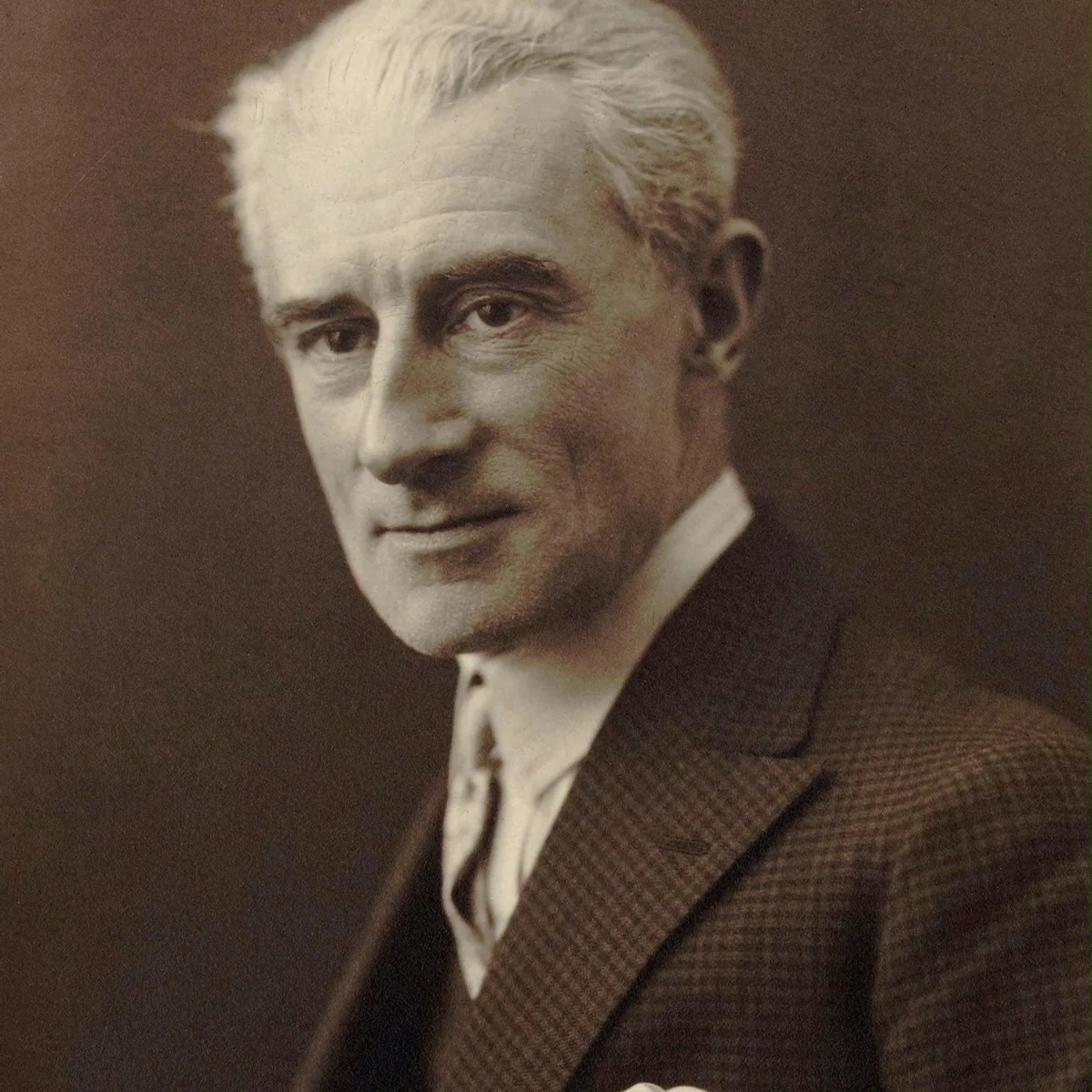
Ravel was born in the Basque town of Ciboure in 1875 and worked in Paris and, from 1921, at Le Belvédère in Montfort-l'Amaury. He is often grouped with Debussy as an Impressionist, a label both rejected. His music is known for clarity and classical forms, and it draws on dance forms such as the pavane, the waltz and the bolero, together with Basque, Spanish and, later, jazz influences. He was a slow, perfectionist worker, wrote no symphonies, and was famous as an orchestrator: several works began as piano pieces that he later orchestrated.
Many of the works here follow those lines. Le Tombeau de Couperin (1914 to 1917) is a piano suite in Baroque dance forms, each movement for a friend who died in the First World War, and it is largely light-hearted. Gaspard de la nuit (1908) sets three prose poems by Aloysius Bertrand; Le Gibet is built around a repeated B-flat tolling in the middle of the keyboard, and Scarbo was meant to be harder than Balakirev's Islamey. The Rapsodie espagnole (1907 to 1908) keeps returning to a descending four-note figure, and its Habanera began as a two-piano piece of 1895.
Tzigane (1924) opens with a long unaccompanied violin passage, mostly on the G string, in a Hungarian Gypsy style. Boléro (1928) alternates two 18-bar melodies over a snare-drum rhythm that never stops, passing the tune from instrument to instrument in a steady crescendo from very soft to very loud. The Piano Concerto for the Left Hand (1929 to 1930, for Paul Wittgenstein) opens with a contrabassoon solo and has jazz-influenced rhythms.
Sources: Maurice Ravel (Wikipedia), Le Tombeau de Couperin (Wikipedia), Gaspard de la nuit, M.55 (IMSLP), Exploring Ravel Gaspard de la nuit (Gramophone), Rapsodie espagnole (Wikipedia), Tzigane (Wikipedia), Boléro (Wikipedia), Piano Concerto for the Left Hand (Ravel) (Wikipedia)
 RavelMenuet antique, M. 7RavelPavane pour une infante défunte, M. 19RavelJeux d'eau, M. 30RavelShéhérazade (song cycle), M. 41RavelString Quartet in F major, M. 35RavelIntroduction and Allegro, M. 46RavelMiroirs, M. 43RavelSonatine, M. 40RavelGaspard de la nuit, M. 55RavelRapsodie espagnole, M. 54RavelMa mère l’Oye, M. 60RavelValses nobles et sentimentales, M. 61RavelPiano Trio in A minor, M. 67RavelLe Tombeau de Couperin, M. 68RavelAlborada del graciosoRavelLa valse, M. 72RavelTzigane, M. 76RavelViolin Sonata No. 2 in G major, M. 77RavelBoléro, M. 81RavelPiano Concerto for the Left Hand in D major, M. 82RavelPiano Concerto in G major, M. 83
Path 21
Two French composers side by side, often compared and often confused, from 1891 to Boléro in 1928.
Debussy → Ravel
Path 15
Fauré, Satie, Debussy, Chausson, Dukas and Ravel, from 1887 to 1920.
Fauré → Satie → Debussy → Chausson → Dukas → Ravel
Path 07
Short, complete works for a single sitting.
Bach → Mozart → Haydn → Beethoven → Schubert → Mendelssohn → Saint-Saëns → Sibelius → Ravel → Debussy → Gershwin → Copland
Path 11
Soloist and orchestra across two and a half centuries, from Bach's harpsichord to Rostropovich's cello.
Bach → Vivaldi → Mozart → Beethoven → Mendelssohn → Tchaikovsky → Dvořák → Rachmaninoff → Ravel → Shostakovich