Path 19
Essential Brahms
Brahms in twelve works, from the First Piano Concerto to the last of his piano pieces.
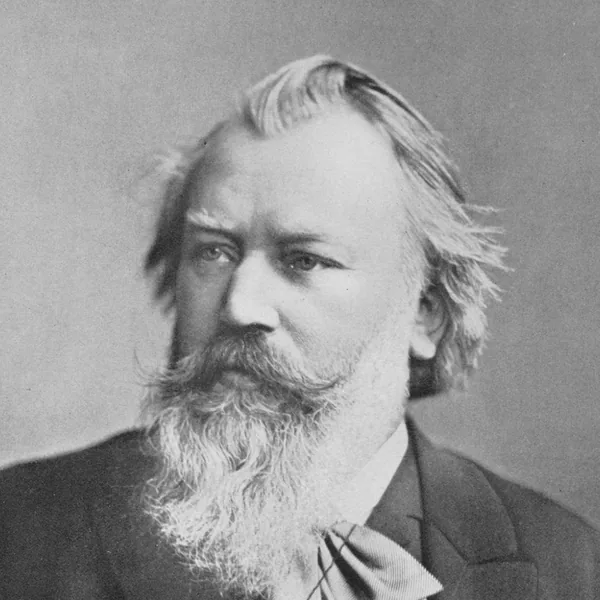
Brahms
1833–1897 · Romantic
84 works
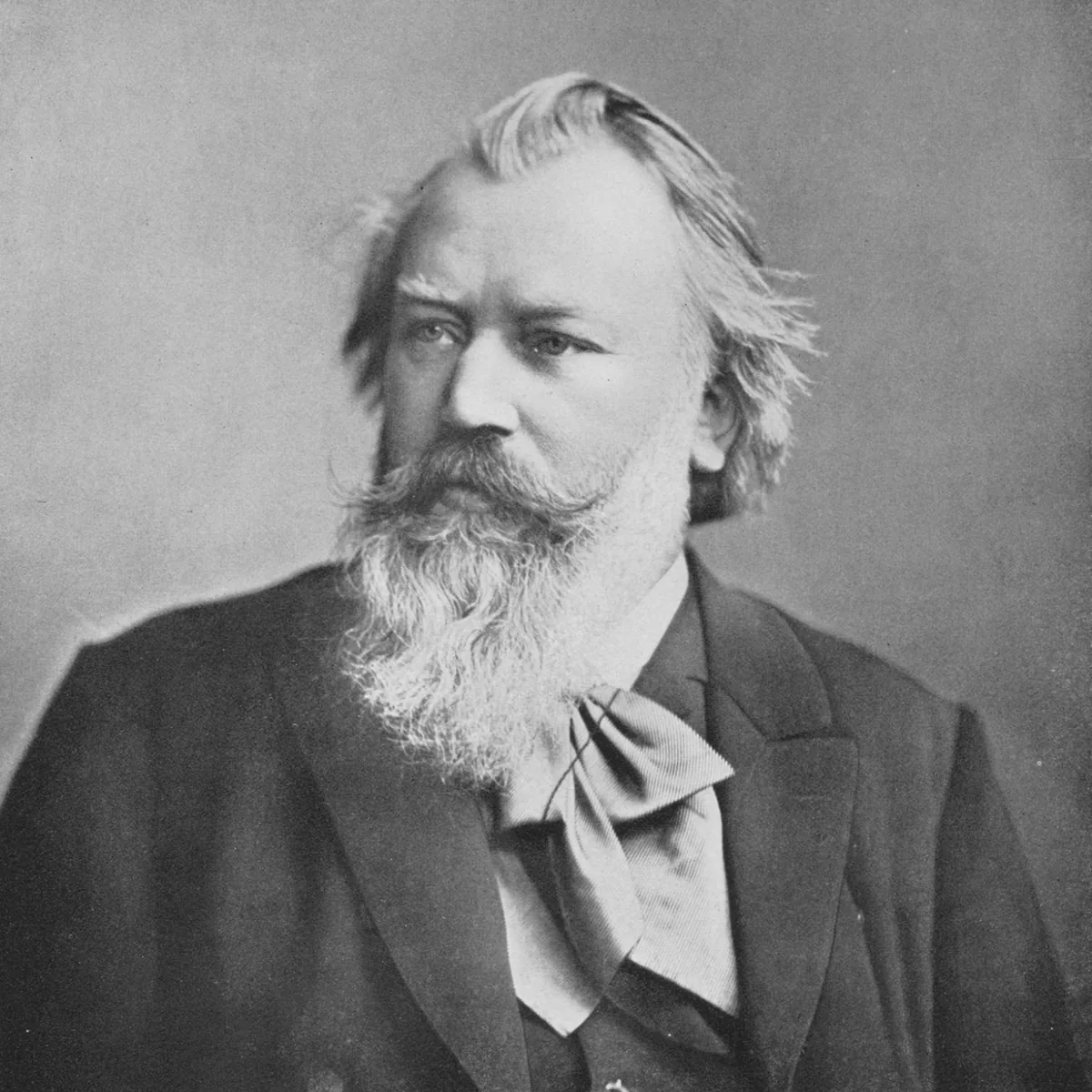
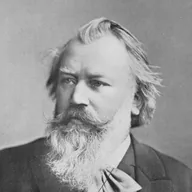
Brahms was born in Hamburg and settled in Vienna in 1862. Robert Schumann's 1853 article "New Paths" had hailed him as a major new talent. He wrote in the Classical forms while the New German School of Liszt and Wagner was moving away from them: four-movement symphonies, sonata-form chamber music, and Baroque forms such as the passacaglia finale of the Fourth Symphony.
His method, which Schoenberg later called developing variation, is to alter small motifs constantly instead of repeating a tune. Cross-rhythms and a Hungarian and Roma colour add rhythmic vitality, as in the Hungarian Dances, which are built on Hungarian dance tunes in csárdás style. The First Symphony took from 1855 to 1876. Its finale's main tune resembles the Ode to Joy of Beethoven's Ninth, and Brahms is reported to have replied that anyone could see that. The finale's introduction has the alphorn melody he sent to Clara Schumann in 1868 with the note "Thus blew the shepherd's horn today!"
The catalog also covers his choral, chamber and piano music. A German Requiem (1865 to 1868) sets texts he chose himself from the Luther Bible, not the Latin Mass. The Piano Quintet in F minor began as a string quintet and passed through a two-piano version. The Haydn Variations (1873) end in a passacaglia on a five-bar bass. For the clarinettist Richard Mühlfeld he wrote the Clarinet Trio, Quintet and Sonatas, and his late piano pieces, Opp. 116 to 119, are mostly intermezzos and capriccios.
Sources: Johannes Brahms (Wikipedia), Symphony No. 1 (Brahms) (Wikipedia), Ein deutsches Requiem (Wikipedia), Hungarian Dances (Brahms) (Wikipedia), Variations on a Theme by Haydn (Wikipedia), Clarinet Quintet (Brahms) (Wikipedia), Piano Quintet (Brahms) (Wikipedia)
 BrahmsScherzo in E-flat minor for piano, Op. 4BrahmsF-A-E Sonata: Scherzo in C minor, WoO 2BrahmsPiano Sonata No. 1 in C major, Op. 1BrahmsPiano Sonata No. 3 in F minor, Op. 5BrahmsFour Ballades for piano, No. 1, Op. 10 No. 1BrahmsFour Ballades for piano, No. 2, Op. 10 No. 2BrahmsFour Ballades for piano, No. 3: Intermezzo, Op. 10 No. 3BrahmsPiano Trio No. 1 in B major (1889 revision), Op. 8BrahmsVariations on a Theme of Robert Schumann for piano, Op. 9BrahmsVariations on a Hungarian Song for piano, Op. 21 No. 2BrahmsVariations on an Original Theme for piano, Op. 21 No. 1BrahmsPiano Concerto No. 1 in D minor, Op. 15BrahmsSerenade No. 1 in D major, Op. 11BrahmsString Sextet No. 1 in B-flat major, Op. 18BrahmsPiano Quartet No. 1 in G minor, Op. 25BrahmsVariations and Fugue on a Theme of Handel for piano, Op. 24BrahmsVariations on a Theme of Paganini for piano, Op. 35BrahmsPiano Quintet in F minor, Op. 34BrahmsSonata in F minor for two pianos, Op. 34bBrahmsCello Sonata No. 1 in E minor, Op. 38BrahmsHorn Trio in E-flat major, Op. 40BrahmsString Sextet No. 2 in G major, Op. 36BrahmsWaltz in B major, Op. 39 No. 1BrahmsEin deutsches Requiem, Op. 45BrahmsHungarian Dance No. 5 in F-sharp minorBrahmsAlto Rhapsody, Op. 53BrahmsEight Piano Pieces, No. 1: Capriccio, Op. 76 No. 1BrahmsSchicksalslied, Op. 54BrahmsString Quartet No. 1 in C minor, Op. 51 No. 1BrahmsString Quartet No. 2 in A minor, Op. 51 No. 2BrahmsVariations on a Theme of Haydn for orchestra, Op. 56aBrahmsVariations on a Theme of Haydn for two pianos, Op. 56bBrahmsPiano Quartet No. 3 in C minor, Op. 60BrahmsString Quartet No. 3 in B-flat major, Op. 67BrahmsSymphony No. 1 in C minor, Op. 68BrahmsSymphony No. 2 in D major, Op. 73BrahmsEight Piano Pieces, No. 2: Capriccio, Op. 76 No. 2BrahmsEight Piano Pieces, No. 3: Intermezzo, Op. 76 No. 3BrahmsEight Piano Pieces, No. 4: Intermezzo, Op. 76 No. 4BrahmsEight Piano Pieces, No. 5: Capriccio, Op. 76 No. 5BrahmsEight Piano Pieces, No. 6: Intermezzo, Op. 76 No. 6BrahmsEight Piano Pieces, No. 7: Intermezzo, Op. 76 No. 7BrahmsEight Piano Pieces, No. 8: Capriccio, Op. 76 No. 8BrahmsViolin Concerto in D major, Op. 77BrahmsTwo Rhapsodies for piano, No. 1, Op. 79 No. 1BrahmsTwo Rhapsodies for piano, No. 2, Op. 79 No. 2BrahmsViolin Sonata No. 1 in G major, Op. 78BrahmsAcademic Festival Overture, Op. 80BrahmsTragic Overture, Op. 81BrahmsNänie, Op. 82BrahmsPiano Concerto No. 2 in B-flat major, Op. 83BrahmsPiano Trio No. 2 in C major, Op. 87BrahmsString Quintet No. 1 in F major, Op. 88BrahmsSymphony No. 3 in F major, Op. 90BrahmsSymphony No. 4 in E minor, Op. 98BrahmsCello Sonata No. 2 in F major, Op. 99BrahmsViolin Sonata No. 2 in A major, Op. 100BrahmsViolin Sonata No. 3 in D minor, Op. 108BrahmsString Quintet No. 2 in G major, Op. 111BrahmsClarinet Quintet in B minor, Op. 115BrahmsClarinet Trio in A minor, Op. 114BrahmsSeven Fantasies for piano (Fantasien), No. 1: Capriccio, Op. 116 No. 1BrahmsSeven Fantasies for piano (Fantasien), No. 2: Intermezzo, Op. 116 No. 2BrahmsSeven Fantasies for piano (Fantasien), No. 3: Capriccio, Op. 116 No. 3BrahmsSeven Fantasies for piano (Fantasien), No. 4: Intermezzo, Op. 116 No. 4BrahmsSeven Fantasies for piano (Fantasien), No. 5: Intermezzo, Op. 116 No. 5BrahmsSeven Fantasies for piano (Fantasien), No. 6: Intermezzo, Op. 116 No. 6BrahmsSeven Fantasies for piano (Fantasien), No. 7: Capriccio, Op. 116 No. 7BrahmsThree Intermezzi for piano, No. 1, Op. 117 No. 1BrahmsThree Intermezzi for piano, No. 2, Op. 117 No. 2BrahmsThree Intermezzi for piano, No. 3, Op. 117 No. 3BrahmsFour Piano Pieces (Klavierstücke), No. 1: Intermezzo, Op. 119 No. 1BrahmsFour Piano Pieces (Klavierstücke), No. 2: Intermezzo, Op. 119 No. 2BrahmsFour Piano Pieces (Klavierstücke), No. 3: Intermezzo, Op. 119 No. 3BrahmsFour Piano Pieces (Klavierstücke), No. 4: Rhapsodie, Op. 119 No. 4BrahmsRomanze in F major, Op. 118 No. 5BrahmsSix Piano Pieces (Klavierstücke), No. 1: Intermezzo, Op. 118 No. 1BrahmsSix Piano Pieces (Klavierstücke), No. 2: Intermezzo, Op. 118 No. 2BrahmsSix Piano Pieces (Klavierstücke), No. 3: Ballade, Op. 118 No. 3BrahmsSix Piano Pieces (Klavierstücke), No. 4: Intermezzo, Op. 118 No. 4BrahmsSix Piano Pieces (Klavierstücke), No. 6: Intermezzo, Op. 118 No. 6BrahmsClarinet Sonata No. 1 in F minor, Op. 120 No. 1 (version with orchestra)BrahmsClarinet Sonata No. 2 in E-flat major, Op. 120 No. 2BrahmsEleven Chorale Preludes for organ, No. 7: O Gott, du frommer Gott, Op. 122 No. 7
Path 19
Brahms in twelve works, from the First Piano Concerto to the last of his piano pieces.
Brahms
Path 14
Two ways of making much from little: a theme changed again and again, and a subject passed from voice to voice.
Bach → Mozart → Haydn → Beethoven → Mendelssohn → Brahms → Elgar
Path 25
Choirs from Handel's coronation anthem to Ligeti's cloud of voices: masses, requiems and psalms, 1727 to 1966.
Handel → Mozart → Brahms → Verdi → Fauré → Orff → Messiaen → Bernstein → Ligeti
Path 02
Twelve symphonies from Mozart's Fortieth to Shostakovich's Fifth, the core of the concert repertoire.
Mozart → Haydn → Beethoven → Schubert → Berlioz → Mendelssohn → Brahms → Mahler → Tchaikovsky → Dvořák → Shostakovich
Path 05
The form behind most first movements, heard twelve times, from a small sonata to a symphony.
Mozart → Haydn → Beethoven → Schubert → Mendelssohn → Brahms → Prokofiev
Path 12
Eleven short pieces from Field to Grieg, each holding one mood.
Field → Schubert → Mendelssohn → Chopin → Schumann → Liszt → Tchaikovsky → Rachmaninoff → Brahms → Grieg