Path 23
Mahler, Bruckner and Strauss
The late Romantic orchestra at its largest: Bruckner's and Mahler's symphonies and Strauss's tone poems, 1880 to 1945.
Bruckner → Mahler → Strauss
1864–1949 · Late Romantic
10 works

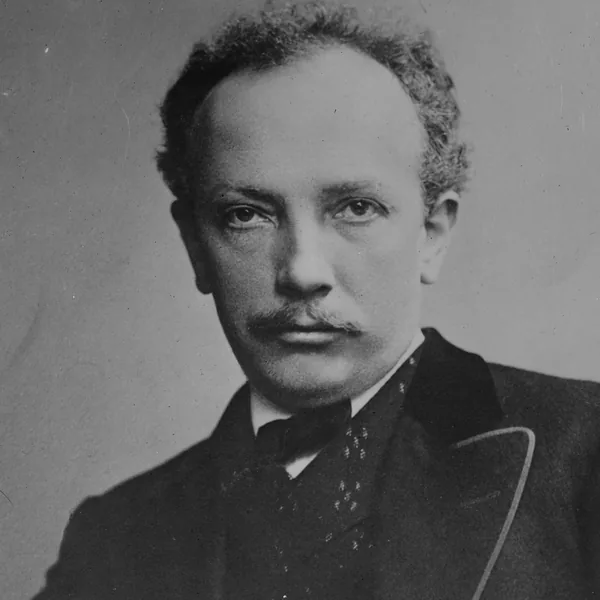
Strauss was born in Munich. His father, Franz Strauss, was principal horn of the Munich Court Opera, and the horn stayed close to his heart. His early works, the Serenade for thirteen winds (1881), the First Horn Concerto (1882 to 1883) and the Burleske for piano (1885 to 1886), follow Schumann, Mendelssohn and Brahms. In 1883 he became assistant to Hans von Bülow at Meiningen, and Alexander Ritter pushed him toward Wagner, Liszt and the tone poem.
His tone poems of 1888 to 1898 tell a story or draw a character with a very large orchestra. Don Juan (1888) is based on a poem by Lenau. Death and Transfiguration (1888 to 1889) follows a dying artist; the poem explaining it was written by Ritter after the music. Till Eulenspiegel is a rondo in which two themes, on horn and on D clarinet, stand for Till's pranks. Ein Heldenleben (1898) has six linked sections and quotes his earlier works. Themes return in changed form, in the manner of Wagner's leitmotifs.
After the tone poems he turned mostly to opera. A late creative burst from 1942 includes the Second Horn Concerto, which looks back to the style of his teens; Metamorphosen (1944 to 1945), for twenty-three solo strings, lamenting the destruction of German cultural life; and the Four Last Songs (1948) for soprano and orchestra.
Sources: Richard Strauss (Wikipedia), Ein Heldenleben (Wikipedia), Don Juan (Strauss) (Wikipedia), Death and Transfiguration (Wikipedia), Till Eulenspiegels lustige Streiche (Wikipedia), Metamorphosen (Wikipedia), Four Last Songs (Wikipedia), Horn Concerto No. 1 (Strauss) (Wikipedia), Horn Concerto No. 2 (Strauss) (Wikipedia), IMSLP: Serenade for Winds, Op.7 (Strauss, Richard), Burleske (Wikipedia)
 StraussSerenade for Winds in E-flat major, Op. 7StraussHorn Concerto No. 1 in E-flat major, Op. 11StraussBurleske in D minor, TrV 145StraussDon Juan, Op. 20StraussTod und Verklärung (Death and Transfiguration), Op. 24StraussTill Eulenspiegels lustige Streiche, Op. 28StraussEin Heldenleben, Op. 40StraussHorn Concerto No. 2 in E-flat major, TrV 283StraussMetamorphosen, TrV 290StraussFour Last Songs, TrV 296
Path 23
The late Romantic orchestra at its largest: Bruckner's and Mahler's symphonies and Strauss's tone poems, 1880 to 1945.
Bruckner → Mahler → Strauss
Path 09
One work for each kind in the catalog, from the symphony to choral music.
Beethoven → Vivaldi → Debussy → Holst → Dvořák → Mozart → Chopin → Scarlatti → Bach → Schubert → Strauss → Handel
Path 13
A poem, a voice and a piano, later an orchestra: from Schubert's first masterpieces to Strauss's last songs.
Schubert → Schumann → Wagner → Mahler → Debussy → Fauré → Strauss